
 For Individuals
 For Enterprises
 Coaching Matters
 International Coaching Week
 Ebooks
 Podcasts
 Blogs
Blogs Community
Can Astrology Really Predict Your Success?
In the gentle rustle of leaves or the quiet rhythm of your breath, there is an invitation—an invitation to pause, to soften, and to surrender. Not the surrender of defeat, but the surrender of trust, of letting go into the arms of life’s unfolding mystery. In a world that often demands control, certainty, and relentless striving, surrender feels like a radical act, a quiet rebellion against the noise of expectation. It is a return to the heart, a remembering of who we are beneath the layers of effort and resistance.
Surrender, as a spiritual practice, is not about giving up but about giving over—handing over our fears, our plans, and our need to know to something greater. It is the art of trusting that the universe, or God, or the infinite wisdom of life, is weaving a story far more beautiful than the one we could orchestrate alone. As a spirituality coach, I’ve witnessed the transformative power of surrender in countless lives, including my own. It is the moment when we stop swimming against the current and allow the river to carry us. It is the moment when we realize that peace is not something we chase but something we allow.
The Weight of Holding On
Sandeep’s story, shared in a poignant conversation, reminds us of the weight we carry when we hold on too tightly. His childhood trauma—a public humiliation at the hands of a teacher—left him silent, retreating from the world for years. It wasn’t just the physical act of being struck that wounded him; it was the shame, the belief that he was “less than,” that clung to him like a shadow. For seven years, he carried this wound, refusing to return to school, hiding from the world. Yet, within that pain was the seed of his transformation. His journey from silence to speaking for ninety-nine hours straight is a testament to the power of surrendering—not to the trauma, but to the possibility of healing, to the courage to rewrite his story.
We all carry our own versions of Sandeep’s story—moments when life bruised us, when we were told we weren’t enough, when we internalized a narrative of fear or failure. These moments become the burdens we hold, the stories we tell ourselves about who we are and what we’re capable of. Surrender invites us to lay these burdens down, to release the need to control the narrative, and to trust that there is a deeper wisdom at work. It asks us to consider: What am I holding onto that no longer serves me? What would happen if I let it go?
The Dance of Surrender and Trust
Surrender is not a single moment but a dance—a continuous movement between holding on and letting go, between effort and ease. It requires trust, a deep knowing that life is not against us, even when it feels that way. When Sandeep spoke of the moment he decided to release the resentment and shame that had defined his early years, he described a conscious choice: to no longer let the poison of the past harm him. He asked himself, Is this emotion helping me or hurting me? That simple question became a gateway to freedom. It was an act of surrender to a higher vision, one where he could be more than his wounds, more than the boy who hid in the bathroom for nine hours.
This dance of surrender is not passive. It is an active choice to align with life’s flow, to trust that even in our darkest moments, there is a purpose unfolding. The spiritual teacher Eckhart Tolle speaks of surrender as “the simple but profound wisdom of yielding to rather than opposing the flow of life.” When we surrender, we stop fighting the current and allow ourselves to be carried. We trust that the river knows where it’s going, even if we cannot yet see the destination.
Consider a time in your life when you felt lost, uncertain, or overwhelmed. Perhaps you fought to control the outcome, to force a solution, only to find yourself exhausted. What might have happened if you had paused, taken a breath, and surrendered to the moment? Not by giving up, but by trusting that the answers would come, that the path would reveal itself. This is the essence of surrender: a willingness to be present, to listen, and to trust.
The Practice of Presence in Surrender
Surrender is deeply intertwined with presence—the art of being fully here, in this moment, without clinging to the past or grasping for the future. When Gaurav shared his story of stumbling upon a cemetery in Austin, Texas, during a time of deep sadness, he described a moment of surrender. Something called him to stop, to enter that sacred space, and to stand before a grave with an inscription that spoke directly to his soul: “If only we could build a staircase from Earth to Heaven, we would have built it. Your loving parents.” The synchronicity of finding twin sisters with his same birth date was not something he could have planned or controlled. It was a gift of the moment, a reminder that life speaks to us when we are present enough to listen.
Presence allows us to hear the whispers of the divine, the subtle nudges that guide us toward healing and purpose. It is in the quiet spaces—between thoughts, between breaths—that we encounter the truth of who we are. Surrender asks us to cultivate this presence, to let go of the need to know and instead be with what is. It is an invitation to trust that the universe is always conspiring in our favor, even when the path feels uncertain.
As a practice, presence can be as simple as pausing to notice your breath, the sensation of your feet on the ground, or the sound of the world around you. It is an act of surrender to the now, a letting go of the mind’s chatter and the heart’s resistance. Try this: Close your eyes and take three slow, deep breaths. With each inhale, imagine you are drawing in peace. With each exhale, release something you’ve been holding—a worry, a fear, a need to control. Notice how your body feels, how your heart softens. This is the beginning of surrender.
The Purpose Beneath the Pain
Surrender also opens the door to discovering purpose, the thread that weaves our experiences into a meaningful tapestry. Sandeep’s journey from trauma to triumph was not just about overcoming fear; it was about finding a purpose greater than himself. He became a teacher, a storyteller, a guide for others seeking to rewrite their own narratives. His pain became the soil for his purpose, a reminder that our deepest wounds often point us toward our greatest gifts.
Purpose is not something we find outside ourselves; it is something we uncover within. It is the quiet knowing that our lives matter, that our stories—however messy or painful—are part of a larger whole. Surrender allows us to release the need to force our purpose and instead let it emerge. It is the trust that every experience, every tear, every triumph, is shaping us into who we are meant to be.
Reflect on this: What if every moment of your life, even the painful ones, is leading you toward your purpose? What if the challenges you’ve faced are not obstacles but invitations to grow, to contribute, to connect? Surrender asks us to trust this process, to believe that life is always working for us, not against us.
Contemplative Practices for Surrender
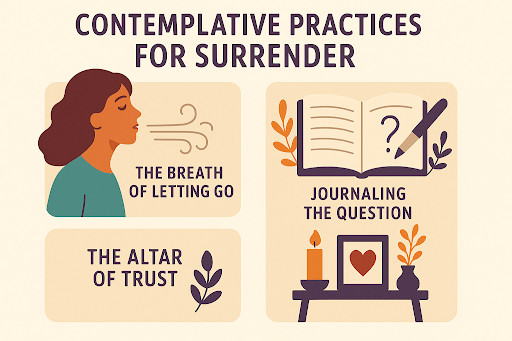
To deepen your journey into surrender, I invite you to explore these gentle practices. They are not tasks to complete but invitations to soften, to listen, and to trust.
The Breath of Letting Go
Find a quiet space where you can be undisturbed for a few minutes. Sit comfortably, close your eyes, and bring your attention to your breath. As you inhale, silently say to yourself, “I am here.” As you exhale, say, “I let go.” Repeat this for five minutes, allowing each exhale to release a thought, a worry, or a need to control. Notice what arises—perhaps a feeling, a memory, or a sense of peace. There is no need to judge or change what comes; simply be with it. This practice helps you cultivate presence and surrender in the moment.
Journaling the Question
Take a moment to reflect on this question: What am I holding onto that no longer serves me? Write freely, without editing, for ten minutes. It might be a belief, a resentment, a fear, or a need to control an outcome. As you write, allow yourself to explore what it would feel like to release this burden. What would your heart feel like if it were free? This practice invites you to name what you’re carrying and gently consider letting it go.
The Altar of Trust
Create a small space in your home—an altar, if you will—where you can place an object that symbolizes surrender. It might be a stone, a candle, or a piece of paper with a word like “trust” written on it. Each day, spend a moment at this altar, offering something you wish to release—a worry, a plan, a fear. You might say silently or aloud, “I surrender this to the wisdom of life.” This practice is a reminder that you are not alone, that you are held by something greater.
A Gentle Invitation
Surrender is not a destination but a journey, a moment-by-moment choice to trust, to be present, and to allow life to unfold. It is the courage to release the stories that no longer serve us and to embrace the ones that call us toward purpose and connection. As Sandeep’s story shows us, even the deepest wounds can become the foundation for a life of meaning. As Gaurav’s cemetery encounter reminds us, life speaks to us in unexpected ways when we are open to listening.
I invite you to pause now, to take a breath, and to ask yourself: What is life asking me to surrender today? Perhaps it is a need to be right, a fear of the unknown, or a story about who you think you should be. Whatever it is, know that you are not alone. The universe is always whispering, always guiding, always holding you in its embrace.
As you move through your day, carry this gentle truth: Surrender is not weakness but strength. It is the strength to trust, to let go, and to allow the river of life to carry you home.